Technopolitical Blog
Surveillance Capitalism: Who Really Owns Your Data?
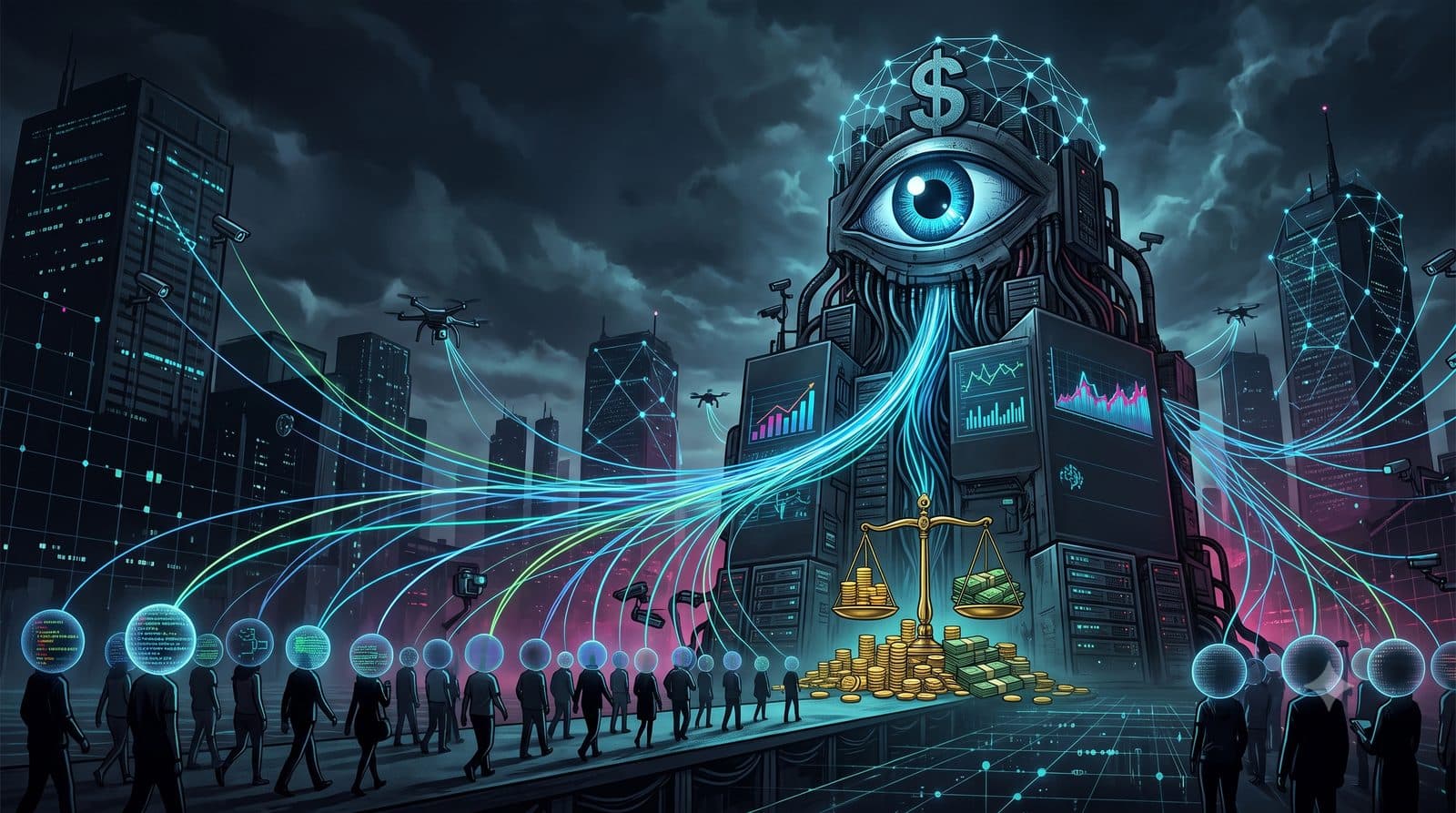
Your smartphone is listening to you. Generative AI reads your messages. Your commutes, your purchases, your likes — all extracted, analyzed, resold. Welcome to the most profitable economy humanity has ever known.
Key takeaways:
- Surveillance capitalism (Shoshana Zuboff) is not an accident — it is a business model
- Generative AI does not invent a new paradigm: it accelerates and amplifies existing surveillance capitalism
- The raw material is no longer oil or steel: it is human experience
- In July 2026, even institutional investors are beginning to factor this risk into their models
2. The Concept: Human Experience as Raw Material
2.1. Shoshana Zuboff's Definition
Shoshana Zuboff, social psychologist and professor at Harvard Business School, published in 2019 The Age of Surveillance Capitalism — a book that would become a foundational reference. Her thesis is radical:
Surveillance capitalism is a new economic regime that claims human experience as free raw material to be transformed into behavioral data. This data is used to predict and modify individual behavior — and these predictions are sold on markets for future behaviors.
| Economic Regime | Raw Material | Product | Purpose |
|---|---|---|---|
| Industrial capitalism | Ore, oil | Manufactured goods | Selling products |
| Information capitalism | Knowledge | Services | Selling services |
| Surveillance capitalism | Human experience | Behavioral predictions | Modifying behavior |
2.2. This Is Not an Accident — It Is an Architecture
Shoshana Zuboff insists on a crucial point: surveillance capitalism is not a "side effect" of digital technologies. It is a deliberate architecture, built on:
Extraction — users produce data for free (clicks, likes, movements, conversations)
Analysis — AI and machine learning transform this raw data into predictive profiles
Modification — profiles are used to steer behaviors (purchases, votes, moods)
Sale — access to these predictions is sold to the highest bidder
"Big Tech has become the owner of civilizational infrastructure: data, information, military capacity, and even the intimate."
— Asma Mhalla, Cyberpunk conference
Video source
2.3. Cognitive Capitalism
Asma Mhalla enriches this analysis by drawing on Yann Moulier-Boutang's concept of cognitive capitalism:
"From the knowledge economy, we moved to cognitive capitalism, to use the term established by Yann Moulier-Boutang. Steve Jobs expressed it in a few words: 'Software is the oil of tomorrow.'"
— Technopolitique, page 64
Where Shoshana Zuboff analyzes the business model, Yann Moulier-Boutang and Asma Mhalla analyze the regime of power: cognition, attention, and affect become the primary resources. The economy no longer sells goods or services — it captures and monetizes the mental activity of its users.
3. In Practice: The Three Ages of Surveillance Capitalism
3.1. The Artisanal Age (1995–2005)
The first advertising models of the internet: basic data is collected (pages visited, searches) to display targeted advertisements. Google AdWords (2000) is the prototype. Users vaguely sense that they are the product, but awareness remains dim.
3.2. The Industrial Age (2006–2019)
The explosion of social networks changes the scale entirely. Facebook, Twitter, Instagram, YouTube become vast extractive machines. Cambridge Analytica (2016) reveals to the general public what insiders already knew:
"Cambridge Analytica (2016) was the first mass cognitive war: the capture of psychographic data to steer and suppress votes."
— Asma Mhalla, Technopolitique conference
Video source
87 million Facebook profiles harvested to influence the 2016 American presidential election and the Brexit referendum. Data extraction was not an end in itself — it was a political weapon.
Timothy Snyder, historian at Yale, analyzes in On Tyranny (2017) how these techniques fit within an authoritarian tradition: "Defend institutions. Do not rush toward the extremes. Be skeptical of prophets." Source
3.3. The Generative AI Age (2022–…)
Generative AI (ChatGPT, Gemini, Claude, Grok) does not create a new surveillance capitalism. It accelerates the previous one. Why?
More data: AI models require astronomical quantities of data to train on
Better predictions: generative AI can infer psychological profiles from free-form text
New extraction vectors: voice assistants, connected glasses, autonomous agents
Asma Mhalla warns of the convergence:
"Hyperspeed technologies, both civilian and military, are transforming the nature of war and politics. They are making each of us, whether we like it or not, into soldiers."
— Technopolitique, central thesis
Carissa Véliz, professor at Oxford, adds in Privacy is Power (2020) that data protection is not a matter of comfort but of power: every piece of data surrendered is one more lever of control.
4. And Tomorrow? — The Future of a Contested Model
4.1. The Market Signal
The Responsible Investor article mentioned above is a weak but significant signal. When asset managers begin to assess "surveillance capitalism" risk, it means:
The concept has left the academic sphere
It is becoming a factor in company valuations
Big Tech could see their cost of capital rise
4.2. European Regulation
Europe is attempting to respond with:
GDPR (2018): personal data protection
Digital Markets Act (2022): regulation of digital markets
AI Act (2024): risk classification of AI systems
But as Asma Mhalla notes:
"Vertical regulatory responses — DSA, DMA, 'switch off the screens' bans — these are twentieth-century answers to a twenty-first-century phenomenon."
— Technopolitique conference
Video source
4.3. Do Alternatives Exist?
Several avenues are emerging:
Common carrier status for platforms, proposed by Asma Mhalla and others
Decentralized models (Mastodon, Bluesky) that separate infrastructure from the business model
Digital sovereignty: localized data, European clouds, algorithmic regulation
Bruce Schneier, in A Hacker's Mind (2023), analyzes how systems are designed to favor certain behaviors — and how they can be subverted:
"Understanding how the system is designed is the first step toward taking back control."
*— Bruce Schneier, A Hacker's Mind
Source
📚 Sources
🎬 Videos
| Source | Link | Subject |
|---|---|---|
| Asma Mhalla — Technopolitique | YouTube | Cognitive capitalism, civil-military duality, Cambridge Analytica |
| Asma Mhalla — Cyberpunk | YouTube | Big Tech, civilizational infrastructure, resistance |
| Asma Mhalla — The Age of AI | YouTube | Generative AI and governance, European lag |
📕 Books
| Work | Author | Year | Relevance |
|---|---|---|---|
| The Age of Surveillance Capitalism | Shoshana Zuboff | 2019 | Founding concept of surveillance capitalism |
| Technopolitique | Asma Mhalla | 2022 | Cognitive capitalism, the Sciency effect, civil-military duality |
| Le capitalisme cognitif | Yann Moulier-Boutang | 2007 | Transition from knowledge economy to cognitive capitalism |
| Privacy is Power | Carissa Véliz | 2020 | Personal data as a question of power |
| A Hacker's Mind | Bruce Schneier | 2023 | Subverting systems, reclaiming control |
| On Tyranny | Timothy Snyder | 2017 | Authoritarian mechanisms and democratic paralysis |
| The Chaos Machine | Max Fisher | 2022 | Algorithmic amplification of polarization |
📄 News Articles
| Source | Link | Subject |
|---|---|---|
| Irish Examiner (22/07/2026) | Read | AI and the acceleration of surveillance capitalism |
| Responsible Investor (24/07/2026) | Read | Surveillance capitalism as investment risk |
Publié le August 17, 2026 par Christophe Wiest
Articles similaires

AI Has Become a Geopolitical Weapon: Welcome to the Multipolar World
Summer 2026 will go down as the moment artificial intelligence stopped being a mere technological topic and became a matter of pure power.
28 août 2026
AI dependence: when the tool becomes a cognitive crutch
"I've lost count of how many times I turn to Claude": this confession from a French entrepreneur, reported by Les Echos, says something about our relationship with artificial intelligence.
27 août 2026

Budget 2027: Connected Agriculture Put to the Test of Lecornu's Promises
On August 15, 2026, Sébastien Lecornu sent farmers an open letter published in the regional press.
26 août 2026