Technopolitical Blog
Budget 2027: Connected Agriculture Put to the Test of Lecornu's Promises
On August 15, 2026, Sébastien Lecornu addressed an open letter to farmers, distributed through the regional press. The Prime Minister announced a series of support and investment measures for agriculture in the 2027 budget, to be presented at the end of September. The third such letter since the start of the year, it came in the wake of the Constitutional Council's validation of the emergency agricultural law. But behind the announcements, one question remains: will French agriculture — digitalising at a rapid pace — see its digital infrastructure needs taken into account?
What the Government Is Promising
The 2027 budget is set to propose support and investment measures for the sector. The emergency agricultural law will be promulgated without delay. Faced with an early and severe drought, the Prime Minister promises a swift response, with targeted funds placed in the hands of prefects to support cash flow and the resumption of production.
These will be supplemented by funds for the public crop loss compensation scheme, reductions in property tax and social contributions for the most vulnerable farms. In the autumn, the draft budget is expected to include a fiscal super-depreciation mechanism for forward-looking agricultural projects, measures to support hydraulic investment, help agriculture adapt to climate change, and preserve the competitiveness of supply chains. Agriculture Minister Annie Genevard has mentioned drought loans and new tax measures.
Connected Agriculture: The Poor Relation of the Announcements
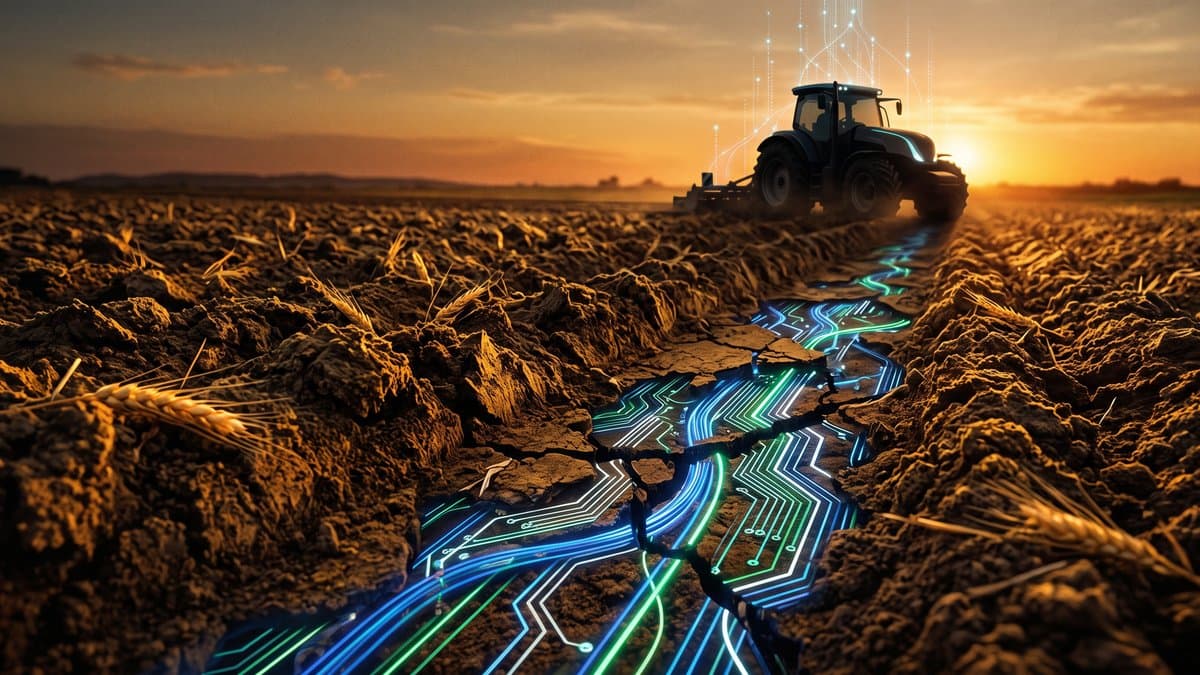
What is striking about these announcements is the near-total absence of any digital dimension. French agriculture is nonetheless in the midst of a profound technological transformation: sensors in the fields, surveillance drones, weather and satellite data, management software, precision farming, traceability. The emergency agricultural law itself contains no specific provisions on rural digital infrastructure.
The disconnect is all the more glaring given that food sovereignty now runs through data. Farms generate vast quantities of information: yields, soil conditions, inputs, weather, prices. This data is coveted by the major agrochemical groups, cooperatives, marketing platforms, and cloud operators. The question of its ownership, exploitation, and protection has become strategic.
Sémaphore and infraSystems: The Lesson of the Novel
This is where Dileviathan offers a framework for understanding. The Sémaphore chapter, whose epigraph quotes Carl von Clausewitz, describes a world in which power is no longer measured solely by armies, but by mastery of information systems. The novel depicts invisible infrastructures — networks, sensors, algorithms — on which daily life depends, and shows what happens when a society loses sight of them.
Asma Mhalla, in Technopolitique : comment la technologie fait de nous des soldats, develops precisely this notion of infraSystems. She shows that modern sovereignty rests on infrastructures that states no longer fully control: clouds, networks, sensors, chips. Agriculture is a textbook case: modern tractors are computers on wheels, their software often owned by foreign manufacturers, their operational data flowing back to distant servers.
The paradox of French agricultural sovereignty mirrors that of the novel: the more production depends on foreign technologies, the more fragile the proclaimed sovereignty becomes. The sensors come from Asia, the software from the United States, the servers from American operators. The question of agricultural data merges with the broader question of digital sovereignty, with one additional blind spot: the rural world.
Agricultural Data: The New Locus of Power
Shoshana Zuboff, in The Age of Surveillance Capitalism, describes how economic value has shifted from data itself to its predictive capacity. Agricultural data is no exception: cross-referenced with weather data, market prices, and satellite imagery, it makes it possible to predict yields, anticipate crises, and steer public policy. Whoever controls this data controls a portion of agricultural policy.
Farmers find themselves in a paradoxical position: as producers of a strategic raw material — their data — they control neither its circulation nor its monetisation. Intermediary platforms capture a growing share of the value in exchange for facilitating connections. The United States and China are investing massively in agritech, while Europe remains fragmented.
France could play a role, provided it chooses to. Agricultural data is a matter of sovereignty, in the same way as health data. Trusted infrastructures, clear rules on data ownership, fair-sharing mechanisms between farmers and industry: these are all projects the 2027 budget could open up, if it incorporates the digital dimension into its definition of forward-looking agricultural projects.
Uncertain Promises
The political calendar adds to the uncertainty. Without a parliamentary majority to pass the budget in the Assemblée, Sébastien Lecornu's promises remain hostage to the balance of power with Parliament. The Prime Minister warns that it will be up to the deputies to take their responsibilities, far from any political considerations tied to the upcoming electoral calendar. With the April 2027 presidential election only months away, everyone will understand what that means.
French agriculture needs three things that the 2027 budget, in its current form, does not guarantee: rural digital infrastructure equal to the challenge, an agricultural data policy that protects farmers against the tech giants, and a long-term vision that does not stop at the next electoral deadline.
The promise of fiscal super-depreciation for forward-looking agricultural projects is a signal. But it still requires defining what those projects actually are — and including the digital within them. Otherwise, the 2027 budget will have funded the agriculture of yesterday, not that of tomorrow.
Key takeaways:
- the digital dimension is the blind spot of the agricultural announcements
- agricultural data is a matter of sovereignty
- without rural digital infrastructure, the budget will fund yesterday's agriculture
The question is not whether the 2027 budget will keep its promises. It is whether France's food sovereignty will include mastery of its agricultural data — or whether it will remain, as in the novel, a semaphore signalling a power it no longer holds.
Sources
Agriculture : les mesures promises par Lecornu dans le budget 2027 — La Tribune
Publié le August 26, 2026 par Christophe Wiest
Articles similaires

Platform regulation: Europe collects, America judges
The week of August 17, 2026 will go down in the annals of digital regulation as the one in which three blows were struck, almost simultaneously, on two continents and under two distinct legal regimes.
29 août 2026

AI Has Become a Geopolitical Weapon: Welcome to the Multipolar World
Summer 2026 will go down as the moment artificial intelligence stopped being a mere technological topic and became a matter of pure power.
28 août 2026

AI dependence: when the tool becomes a cognitive crutch
"I've lost count of how many times I turn to Claude": this confession from a French entrepreneur, reported by Les Echos, says something about our relationship with artificial intelligence.
27 août 2026