Technopolitical Blog
AI dependence: when the tool becomes a cognitive crutch
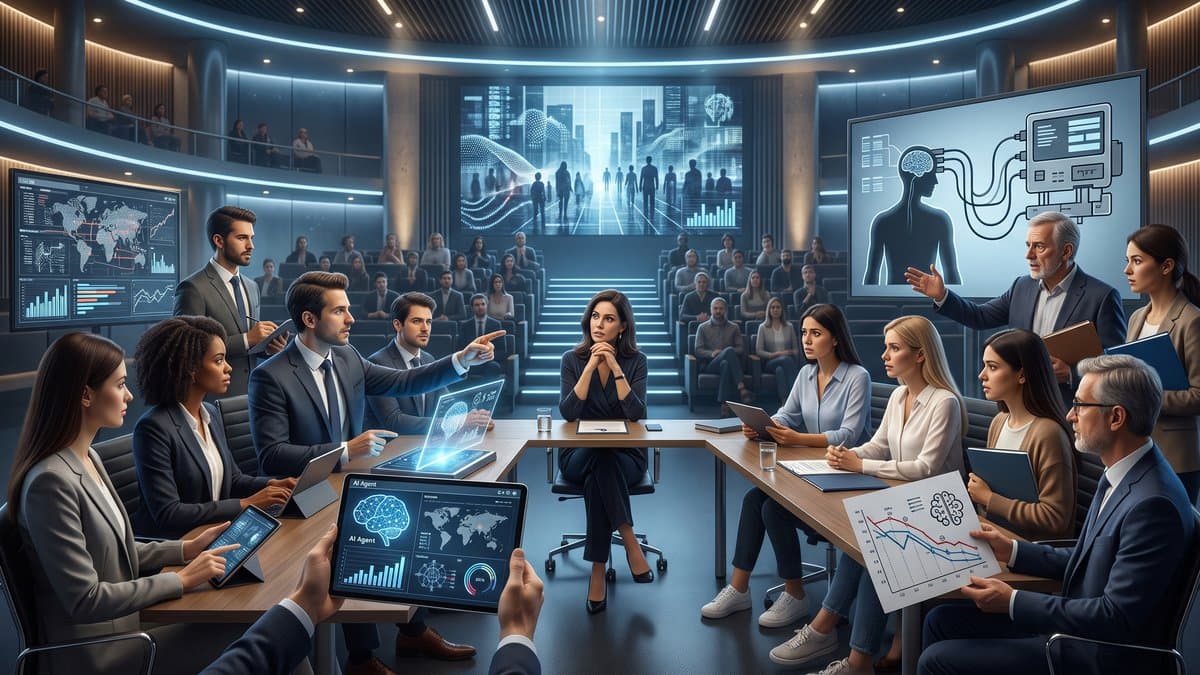
"I've lost count of how many times I turn to Claude": this confession from a French entrepreneur, reported by Les Echos, says something about our relationship with artificial intelligence. He is not talking about a tool one reaches for occasionally, like a dictionary or a calculator. He is talking about a reflex, a constant and almost involuntary solicitation. Anthropic's assistant has become his first point of contact — before even his own colleagues. The candor demands attention because it sketches a situation many will recognize: we have reached the point where asking a question of a machine has become more natural than asking it of a human.
This personal observation, however, sits in tension with a macroeconomic reality that investors are beginning to eye with unease. The widely shared video "AI Productivity Gains Aren't Arriving: Why Does Everyone Keep Going?" documents this paradox: companies are spending billions on infrastructure, models, and subscriptions. Data centers are multiplying. Copilot licenses number in the millions. And yet measurable productivity gains remain elusive. GDP per capita figures, hourly productivity rates — none show any inflection. We are spending as though the transformation were already here, but working in the same volumes, under the same constraints. Part of the explanation is trivial: adopting a tool is not enough; work must be reorganized around it. But another part is more troubling: what if the tool, rather than augmenting our capacities, were cannibalizing them?
A Les Echos columnist raises this risk in a sharply titled op-ed: "The great risk is that humans will turn themselves into poor computers." The argument is straightforward. When we massively outsource reflection, writing, synthesis, and decision-making, we lose, through atrophy, the ability to do these things ourselves. Reasoning becomes a sequence of prompts. Memory shrinks to navigating conversation histories. Judgment — that faculty for weighing the relevant against the incidental — is delegated to a statistical model that knows only precedent. The author adds a phrase worth keeping: by delegating everything to AI, the human loses the capacity to "see differently" — that is, to think alongside the data, to take paths that probability does not anticipate. This is the capacity we call intuition, perspicacity, or simply intelligence.
The public debate is beginning to catch up. On the program Répliques on France Culture, contributors asked whether there is a "right use" of artificial intelligence. The question might seem naïve: we do not ask whether there is a right use of a hammer. But AI is not a hammer. It is a system that responds before we have finished thinking, that proposes before we have formulated, that completes before we have decided. The question of right use is therefore not a question of etiquette. It is a question of cognitive sovereignty: how far are we willing to delegate our judgment to machines whose workings we do not understand and whose purposes we do not control?
Shoshana Zuboff, in her foundational work The Age of Surveillance Capitalism, described this mechanism better than anyone. Her analysis begins with an observation: surveillance capitalism does not manufacture goods or services. It manufactures behavioral predictions from human experience transformed into raw data. Every click, every search, every like, every second of attention is a raw material that algorithms convert into a forecast of what we will do, buy, think, or vote. The final product is not the data itself. It is the predictions. And those predictions are sold to whoever has an interest in knowing them: advertisers, insurers, platforms, governments.
This mechanism is staged with chilling precision in Dileviathan, in chapter 11, "The Burning Mirror." Zara, one of the central characters, describes her work at Capgemini on recommendation algorithms. She says: "I could predict what you were going to buy in the next three days. I could predict who you were going to vote for. With a margin of error of less than five percent." The algorithms she designed did not merely influence consumer behavior. They predicted mental health crises, depressions, suicide attempts. These predictions were sold to insurance companies to adjust premiums. Fiction here meets Shoshana Zuboff's thesis point for point: human experience, captured, analyzed, transformed into prediction, becomes a tradeable asset.
The parallel with everyday dependence on conversational agents is direct. Assistants like Claude, ChatGPT, or Gemini are the consumer-facing interfaces of this prediction infrastructure. They do not merely respond: they anticipate, they format, they suggest. And the more we use them, the more data we supply to refine their models. The loop is virtuous for the companies that develop them. It is more questionable for us.
Asma Mhalla, in her book Technopolitique, offers a framework that illuminates this dynamic from a different angle. For her, technology does not merely make us consumers or citizens. It makes us soldiers. Not in the military sense, but in the sense that we are permanently mobilized, without knowing it, in a war of attentions, behaviors, and decisions. Every interaction with a digital tool is an engagement in a dispositif whose rules escape us. Cognitive delegation is not a service. It is a recruitment.
And this is where chapter 5 of Dileviathan, "The Mirror Stage," takes on its full meaning. The title refers to Jacques Lacan's concept: the moment when the child, before its reflection, recognizes its image while sensing that the image eludes it. This image is both the child and not the child. In our relationship with artificial intelligences, we live an analogous experience. AI returns to us a version of ourselves: our words, our ideas, our reasoning — reformatted, smoothed, optimized. But this image is not us. It is a statistical reflection, stripped of that "otherness" which Lacan considered essential to the constitution of the subject. We risk recognizing ourselves in the machine without noticing that the machine has remolded us in its own image.
The central question is not whether AI is useful or dangerous. It is both, like most powerful technologies. The question is whether we are still capable of distinguishing the prosthesis from the organ. A tool that actively replaces us in essential cognitive functions is no longer quite a tool. It is a substitute. And the substitute, used long enough, ends up defining what it replaces.
The real danger is not that machines will become too intelligent. It is that we will stop exercising our own.
Sources
"The great risk is that humans will turn themselves into poor computers" — Les Echos
AI Productivity Gains Aren't Arriving: Why Does Everyone Keep Going? — YouTube
Is there a right use of artificial intelligence? — France Culture, Répliques
Publié le August 27, 2026 par Christophe Wiest
Articles similaires
Platform regulation: Europe collects, America judges
The week of August 17, 2026 will go down in the annals of digital regulation as the one in which three blows were struck, almost simultaneously, on two continents and under two distinct legal regimes.
29 août 2026
AI Has Become a Geopolitical Weapon: Welcome to the Multipolar World
Summer 2026 will go down as the moment artificial intelligence stopped being a mere technological topic and became a matter of pure power.
28 août 2026
Budget 2027: Connected Agriculture Put to the Test of Lecornu's Promises
On August 15, 2026, Sébastien Lecornu sent farmers an open letter published in the regional press.
26 août 2026