Technopolitical Blog
AI Has Become a Geopolitical Weapon: Welcome to the Multipolar World
Three weeks that changed everything: Xi Jinping launches his AI+ doctrine, Washington accuses Beijing of siphoning, and Microsoft sells Europe a sovereignty it doesn't have.
The summer of 2026 will be remembered as the moment artificial intelligence ceased to be merely a technological subject and became an instrument of raw power. In the space of three weeks, three major events redrew the geopolitical map of AI: Xi Jinping's landmark speech in Shanghai, the White House's accusations against Chinese AI Kimi, and the Microsoft-Mistral partnership that raises serious questions about what "digital sovereignty" actually means for Europe.
This is the world the novel Dileviathan describes from its very first chapter: one in which the algorithmic machine no longer serves politics — it conducts it. The epigraph to Sémaphore recalls Carl von Clausewitz's formula: "War is merely the continuation of politics by other means." In 2026, that continuation runs through models, data, and computing infrastructure. A breakdown of a world polarising at breakneck speed.
1. China: the AI+ doctrine takes the stage
On 17 July 2026, Xi Jinping delivered his first address at the World Artificial Intelligence Conference in Shanghai. The Chinese president unveiled what Le Grand Continent calls the "AI+ doctrine": a systematic plan to integrate AI across every economic sector, modelled on the "Internet+" initiative launched in 2015.
Xi proposed nothing less than a "fair and equitable global AI governance" framework under the auspices of the United Nations, while announcing the creation of a World Organisation for Artificial Intelligence Cooperation, to be headquartered in Shanghai. The speech quoted Chinese classics and promised a "symphony" of multilateral cooperation against a hegemon he did not name but whom everyone recognised.
Behind the scenes, it was Moonshot AI that stole the show. The startup unveiled Kimi K3, presented as the largest open model in the world, with performance said to surpass that of systems from Anthropic and OpenAI. The Chinese strategy is transparent: release model weights for free to create global dependency, then lock down the ecosystem once the American lead begins to falter.
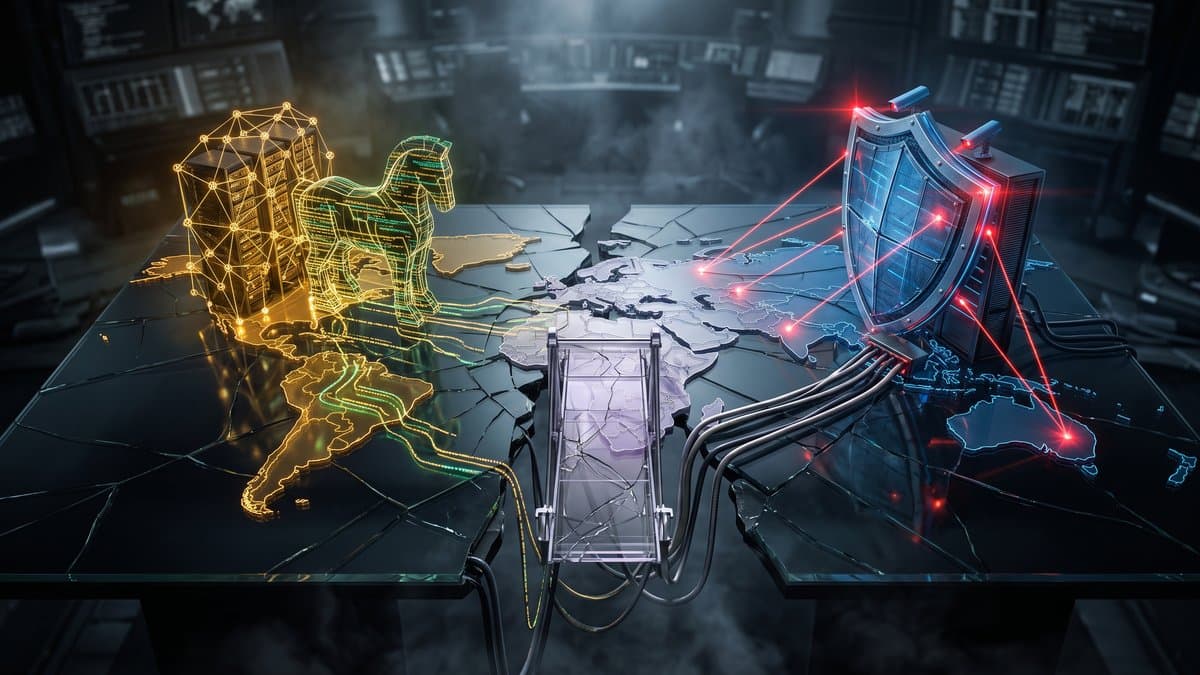
"The day the adversary's innovation runs out of steam, nothing would compel Beijing to publish the next generation," analyses Le Grand Continent. This is precisely the Trojan horse principle: offer what looks like a gift, while retaining control over its terms in the long run.
It is also the principle of the Diffusion — the weapon of the eponymous chapter in the novel: disseminate models, narratives, open "truths," until the world organises itself around them. Generosity is never innocent. It is a form of power that dares not speak its name.
2. Washington strikes back: the Kimi affair
The counterpunch was not long in coming. A few days after the Kimi K3 presentation, Michael Kratsios, Donald Trump's technology adviser at the White House, published an explosive accusation on X, reported by Le Figaro: Moonshot AI had allegedly "distilled" Claude Fable 5, Anthropic's most advanced model.
Distillation is a well-known and widely used technique in the industry, consisting of training one model on the outputs of another in order to reproduce its capabilities at lower cost. But a public accusation from the United States' most senior technology adviser changes the stakes entirely: it officially declares open rivalry between the two powers on the AI front.
The parallel with the cognitive warfare in the novel is striking. In Dileviathan, Gabriel's campaign is torpedoed by deepfakes and fabricated narratives before a single vote is cast. Here, the weapons have changed in nature: it is no longer voters being siphoned, but the models that will influence them. The Clausewitz epigraph takes on its full meaning: technology has become the continuation of politics by other means, and intellectual property its battlefield. The American administration sends a clear signal: China is using open source as a diplomatic Trojan horse, and the United States will not stand by without responding. The Chinese message — multilateral symphony, openness, sharing — and the American response — accusation, defence of intellectual property, implicit sanctions — sketch two irreconcilable visions of the digital world.
3. Europe caught in the vice: the false sovereignty of Microsoft-Mistral
While Washington and Beijing clash, Europe searches for its footing. And this is where the partnership between Microsoft and Mistral AI takes on its full significance, as dissected by Clubic.
The deal is substantial: Microsoft commits several billion dollars to exploit Mistral's European GPU capacity, soon to be bolstered by the latest-generation Nvidia Vera Rubin chips. In return, Mistral Medium 3.5 joins Microsoft Foundry and Copilot Studio, while the OCR 4 model (document processing) arrives in Foundry. Azure and Azure Local serve as the shared execution foundation.
Three deployment modes are highlighted: standard public cloud, a "cloud-connected" mode in which the company retains control of its own infrastructure while synchronising with Azure, and a fully disconnected mode, presented as the solution for the most sensitive environments. The word "sovereignty" appears in every paragraph of the press release.
Except that digital sovereignty has a precise meaning in France. The SecNumCloud version 3.2 framework from ANSSI requires immunity from extraterritorial laws, including the American CLOUD Act. A requirement that Azure, even in partnership with Mistral, cannot meet as long as Microsoft remains a company subject to US law. The press release makes no mention whatsoever of SecNumCloud or Bleu, the joint venture created by Orange and Capgemini with Microsoft in an attempt to meet that requirement.
This is where the novel intersects with reality in the most unsettling way. In Dileviathan, Zara works at Capgemini on recommendation algorithms: she predicts what people buy, watch, and even how they vote, with a margin of error of less than five per cent. The very company that employs the novel's predictor is today building, alongside Microsoft, Europe's "sovereign" cloud. The question is not the competence of the engineers. It is a matter of knowing who owns the data flowing through these machines, and what "it all depends on what you put into it" means — to borrow the Gilles Deleuze epigraph that opens Le Fantôme dans la Machine: an infrastructure one does not control, however "sovereign" its label, remains an infrastructure whose power lies elsewhere.
Arthur Mensch, CEO of Mistral, acknowledged as much between the lines. Questioned by Reuters on the day of the announcement, he admitted that the deal showed above all "how the two companies are working together to bridge the infrastructure gap in Europe." An admission that speaks volumes about the Old Continent's structural lag in computing capacity. Meanwhile, S3NS, the joint venture between Thales and Google Cloud, secured its SecNumCloud qualification as early as December 2025 for its Premi3ns offering. Microsoft therefore trails Google on this specific front — something the 21 July press release is careful not to mention. The deal also includes no new equity stake by Microsoft in Mistral, despite persistent rumours of an upcoming fundraising round.
What this changes for us
For European organisations subject to regulatory obligations — Operators of Vital Importance, public administrations, healthcare institutions — this Microsoft-Mistral partnership changes nothing. Azure is still not SecNumCloud-qualified, and Bleu is still not commercially available. The technical milestone for Bleu was validated in April 2025, but full availability is not announced until the second half of 2026.
For organisations seeking primarily operational flexibility without strict regulatory constraints, the offering has the merit of existing. But it does not resolve the underlying problem.
And beyond the technical considerations, the broader picture is stark. AI has become the weapon of a three-way competition, and each camp is playing its own part: China uses open source as a diplomatic and technological tool to extend its influence; the United States defends its lead through accusation and regulation; Europe attempts to forge a credible path without the resources of either.
In this multipolar world, the question is no longer which AI performs best. It is a matter of knowing to which camp we entrust our data, our infrastructure, and ultimately our capacity to make decisions.
Sources:
Microsoft s'allie à Mistral AI pour booster l'IA en Europe, Le Monde Informatique
Xi Jinping appelle à une stratégie nationale pour l'IA, Le Monde
La Maison-Blanche accuse l'IA chinoise Kimi d'avoir siphonné le savoir-faire d'Anthropic, Le Figaro
Publié le August 28, 2026 par Christophe Wiest
Articles similaires
Platform regulation: Europe collects, America judges
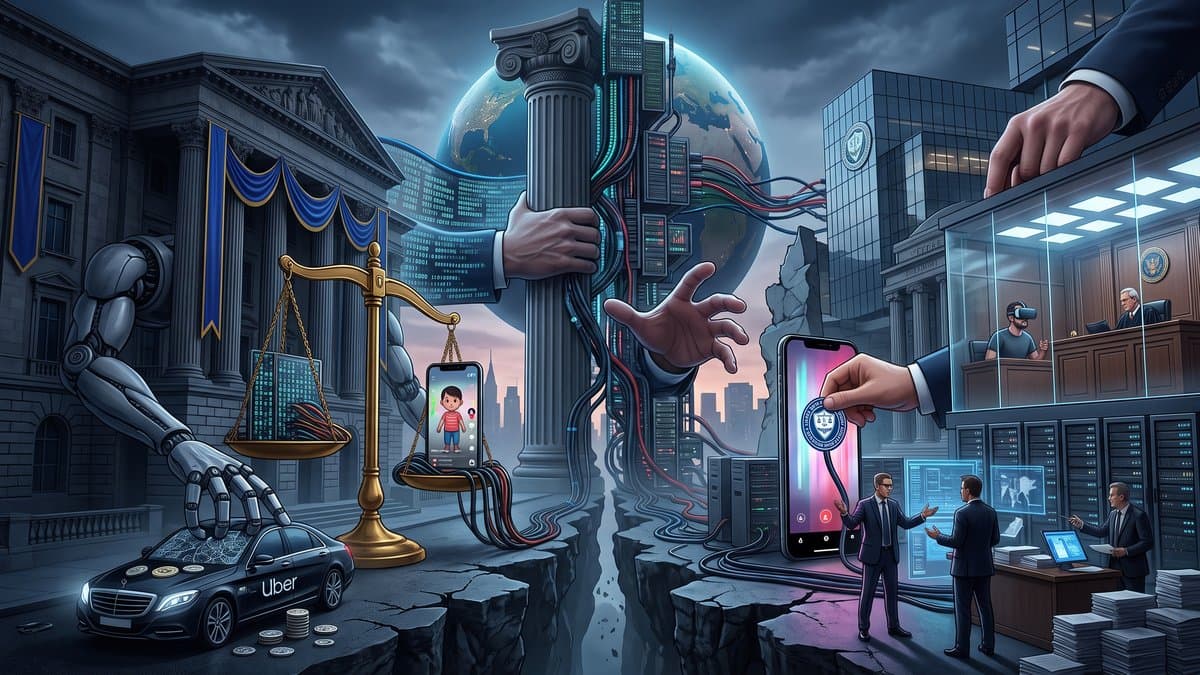
The week of August 17, 2026 will go down in the annals of digital regulation as the one in which three blows were struck, almost simultaneously, on two continents and under two distinct legal regimes.
29 août 2026
AI dependence: when the tool becomes a cognitive crutch
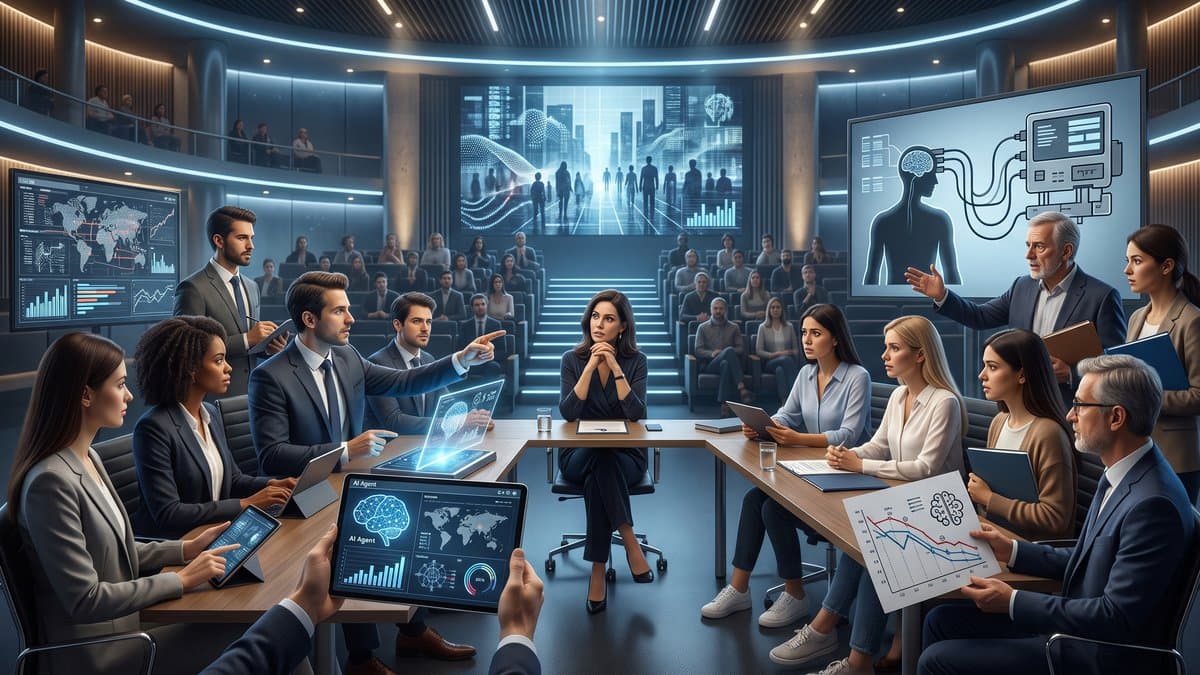
"I've lost count of how many times I turn to Claude": this confession from a French entrepreneur, reported by Les Echos, says something about our relationship with artificial intelligence.
27 août 2026

Budget 2027: Connected Agriculture Put to the Test of Lecornu's Promises
On August 15, 2026, Sébastien Lecornu sent farmers an open letter published in the regional press.
26 août 2026