Technopolitical Blog
Why This Novel?
Everything began two years ago, in the middle of a sleepless night.
Like many of us, I was spending those quiet hours scrolling through the news on my favorite app. Until the day I came across an essay that changed everything: Technopolitique — Comment la technologie fait de nous des soldats, by Asma Mhalla.
I didn't know it yet, but that reading was about to set something unexpected in motion.
The Spark
That book opened my eyes to a reality I had sensed without knowing how to name it. That vague feeling that something was off in our relationship with technology. That vertigo when you realize the tools you use every day are not neutral — that they shape your perceptions, capture your attention, short-circuit your ability to think for yourself.
For twenty years, I worked in telecommunications. I helped deploy networks, launched products, industrialized technologies that were supposed to connect people, bring the world closer together, build bridges. That was partly true. But Asma Mhalla showed me the other side of the picture. Those same infrastructures have become instruments of control and capture. The bridges are also toll roads.
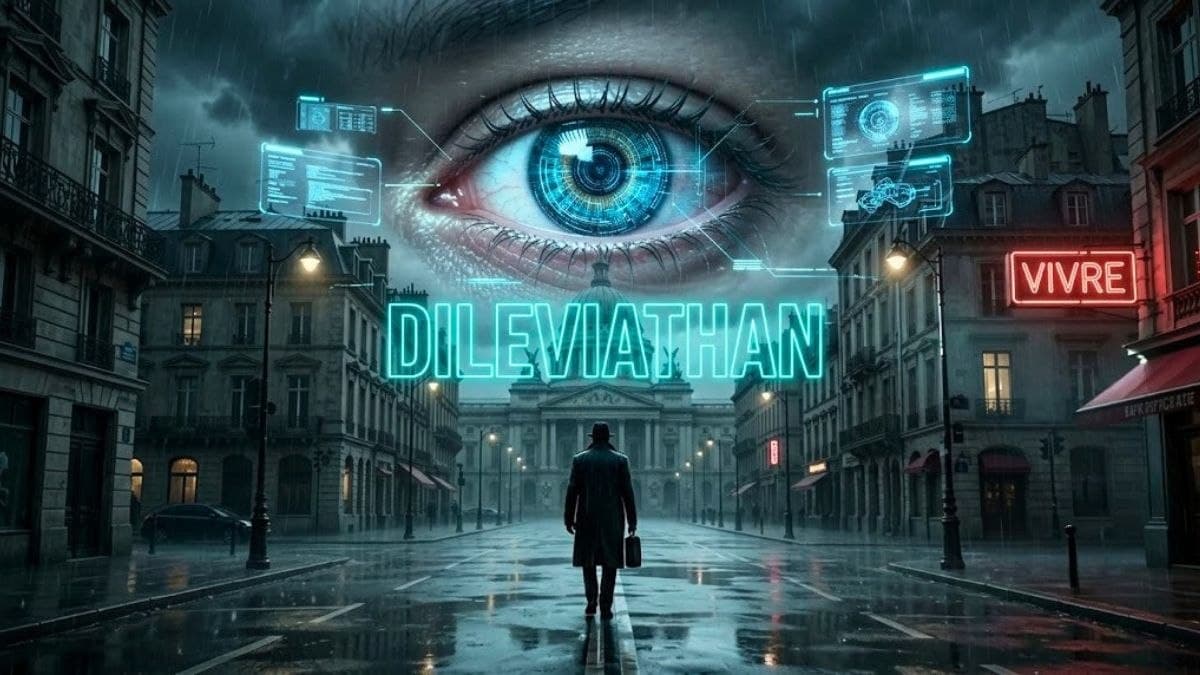
The Dileviathan is the name she gives to this fusion of Big State and Big Tech. A hybrid power that no longer operates through law but through the architecture of systems that capture our attention and shape our perceptions.
The more I read, the more my own career took on a new meaning. And then, suddenly, the realization that I had contributed, at my own scale, to laying the foundations of this world. Not out of cynicism — simply because no one had ever told me the story from that angle.
So I started writing.
The Need to Tell
At first, it was nothing. Just notes scrawled between 3 and 5 in the morning during my bouts of insomnia. A way of putting words to what I was discovering.
I had no plan. Just an obsession: how do you explain to a friend what the Big State is? How do you make someone understand in thirty seconds why the fusion of the state and the tech giants is one of the greatest democratic challenges of our century?
I tried conversations, debates, LinkedIn posts. Nothing worked. These concepts are too abstract, too theoretical. They slide off the mind like water off feathers.
That's when the idea took root: what if I told a story?
Explaining Without Betraying
The wager was simple: take complex concepts — cognitive saturation, the dissolution of public debate, surveillance capitalism — and embody them in characters and concrete situations.
A dystopian novel, yes. But not for the thrill of it. So that the reader could experience the mechanisms from the inside.
I rebuilt the manuscript several times. I was learning as I wrote; each version clarified my own understanding. Fiction was becoming a tool for thought.
Dileviathan is a novel that aims to be accessible, easy to read. Designed to hold the attention of someone opening a book on their sofa in the evening, not a scholar in a seminar room. But behind every scene and every line of dialogue lie years of reading and questioning.
The Inspiration of Robot 1er
It was watching the work of Frédéric Mazalla and his serialized novel Robot 1er go by that the idea of distribution struck me.
His approach — publishing one chapter at a time, creating a regular appointment with readers, building a community around a narrative — seemed like an obvious path. I have neither his profile nor his entrepreneurial reach, but the idea of offering this story chapter by chapter, by email and on this site, convinced me to take the plunge.
At my own scale.
Don't Expect Asimov
Let's be honest: if you're looking for the next Isaac Asimov or Philip K. Dick, look elsewhere. I'm not a professional writer. I'm a telecom engineer who spent twenty years tinkering with routers, not chiseling metaphors.
But the idea is there. The narrative arc is solid — it occupied my mind for years before finding its shape. The characters have their flaws, their convictions, their contradictions.
And above all, the mechanisms this novel describes are not science fiction. They are already at work, in plain sight, every day.
This book is a work of fiction. Let's hope it stays that way.
But if you come away from it with one more question about what your digital tools are doing with your attention — or about that strange feeling that politics is starting to look more and more like an app — then this novel will have done its job.
That's all I ask: that you close this book seeing the world a fraction of a second differently. That when you encounter a piece of information that seems a little too obvious, you ask yourself: who benefits from my thinking this?
Welcome to Dileviathan. Welcome to our world.
How This Novel Was Written
This novel was written with the help of open-source tools, 100% hosted in France.
The primary writing assistant is Hermes Agent, developed by Nous Research. It runs on an OVH VPS, in France. It helped me structure the narrative arc, track the logical development of the characters, and maintain overall consistency over time.
The writing pipeline runs through Autonovel, a tool adapted to let me keep control of the story at every stage. I write, I decide, I validate, I revise. The tool alerts me if I stray from the narrative arc.
The language model used is Mistral NeMo, a French open-source model, running locally on my own infrastructure. No data leaves France, no training on my texts, no leaks.
The ideas, the words, the narrative choices are mine. The AI helped me not to lose my way along the road. That's all.
Publié le August 1, 2026 par Christophe Wiest
Articles similaires
Platform regulation: Europe collects, America judges
The week of August 17, 2026 will go down in the annals of digital regulation as the one in which three blows were struck, almost simultaneously, on two continents and under two distinct legal regimes.
29 août 2026
AI Has Become a Geopolitical Weapon: Welcome to the Multipolar World
Summer 2026 will go down as the moment artificial intelligence stopped being a mere technological topic and became a matter of pure power.
28 août 2026
AI dependence: when the tool becomes a cognitive crutch
"I've lost count of how many times I turn to Claude": this confession from a French entrepreneur, reported by Les Echos, says something about our relationship with artificial intelligence.
27 août 2026