Technopolitical Blog
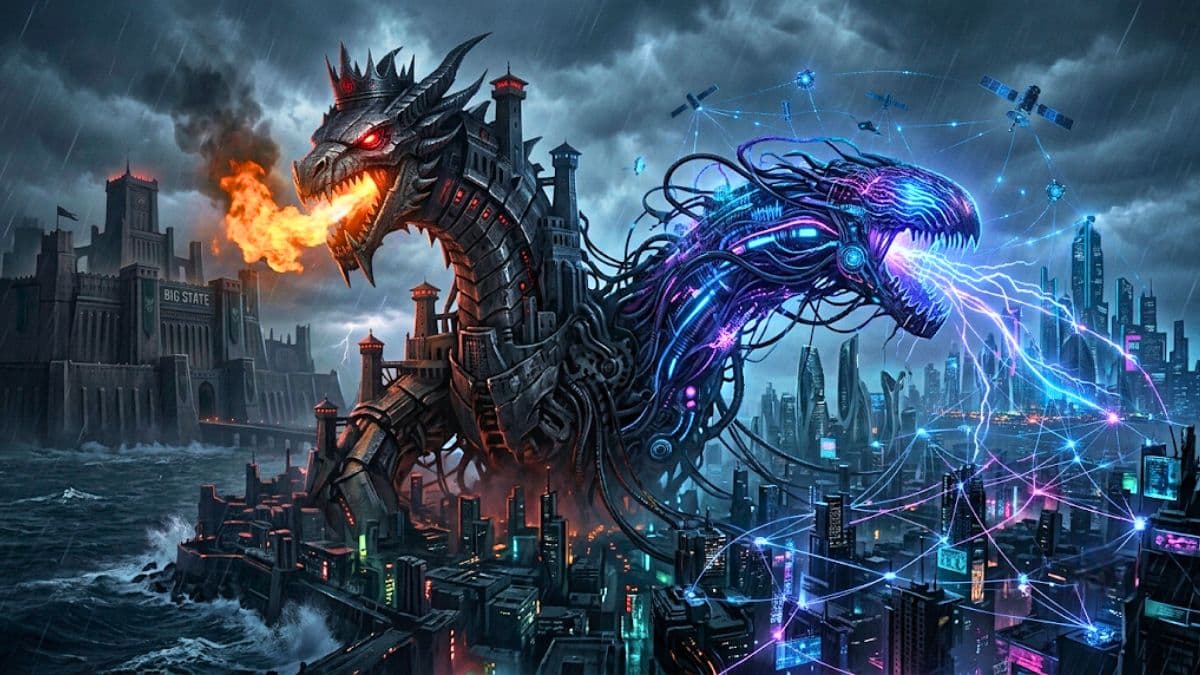
The Dileviathan: Big State and Big Tech, a User's Guide
How did a Mesopotamian myth become the key to understanding power in the twenty-first century?
Key takeaways:
- The "Dileviathan" is a concept coined by Asma Mhalla, merging the statist Leviathan (Thomas Hobbes) with the power of tech giants
- It describes a two-headed power: Big State (vertical sovereignty) + Big Tech (horizontal reach)
- Only the United States and China are true Big States — Europe is absent from this equation
- Understanding this architecture is essential for reading today's geopolitical and technological landscape
1. The spark: when reality catches up with fiction
In 2024, Elon Musk unveils Grok, his "anti-woke" AI, a direct rival to ChatGPT. That same year, xAI raises six billion dollars to build the world's largest computing cluster in Memphis, Tennessee. Meanwhile, Starlink by SpaceX provides internet access to the Ukrainian military, and Palantir signs multi-billion-dollar contracts with the Pentagon for its algorithmic targeting systems.
A single thread connects these events: private companies are performing functions that, barely twenty years ago, were the exclusive preserve of states.
This is not a conspiracy theory. It is an architecture of power that political scientist Asma Mhalla has named the Dileviathan — a fusion of Thomas Hobbes's Leviathan and the power of tech giants.
"Power is now two-headed and shape-shifting. The Leviathan has two heads: one orchestrates the heat while the other codes the system."
— Asma Mhalla, Cyberpunk: le nouveau système totalitaire (Seuil, 2025)
2. The concept: a two-headed power
2.1. Where does the Dileviathan come from?
The term was coined by Asma Mhalla in her first book, Technopolitique : comment la technologie fait de nous des soldats (Seuil, 2022). It combines:
- Leviathan: the figure of the biblical monster adopted by Thomas Hobbes (Leviathan, 1651) to symbolize the sovereign state, holder of the monopoly on legitimate violence
- Big Tech: the technology giants (Meta, Alphabet, Amazon, Microsoft, X-Corp) that have acquired unprecedented economic, diplomatic, and informational power
"What is new is that Big Tech companies have become the owners of civilizational infrastructure: data, information, military capability, and even the intimate."
— Asma Mhalla, Cyberpunk conference
2.2. The two heads
Asma Mhalla draws a rigorous distinction between two concepts, borrowed from Raymond Aron:
| Head | Type | Logic | Example |
||------|-------|---------|
| Big State | Vertical power | Sovereignty, territorial control, state prerogative | United States, China |
| Big Tech | Horizontal reach | Projection, infrastructure, data | Google, Meta, SpaceX, Palantir |
"Power is not necessarily the same as might — they are two different things. Power is vertical, statist, sovereign. Might is horizontal; it projects outward. Big Tech companies have might; states still have power."
— Asma Mhalla, Technopolitique conference, Mollat Bordeaux
2.3. Only two Big States in the world
Asma Mhalla is unequivocal on this point:
"In the world, there are only two Big States: the United States and China."
— Cyberpunk conference
Why? Because a Big State is a state that combines:
- An indigenous technological power base (GAFAM, BATX)
- A capacity for global military and economic projection
- A codependent relationship with its tech giants — neither fusion nor separation
The consequence is stark: Europe is not part of this game. As Asma Mhalla puts it:
"Big Tech only emerges where there is a Big State. Europe has neither a major technology player nor a strategy of power."
— Technopolitique conference
3. In the real world: the Dileviathan in action
3.1. Ukraine: the laboratory
The war in Ukraine was the first conflict in which the Dileviathan deployed itself on a large scale:
- Starlink (SpaceX/Elon Musk): essential communications infrastructure for the Ukrainian military, controlled by a single individual
- Palantir (Peter Thiel): military targeting software used by the Pentagon and Ukraine
- Microsoft and Amazon: military cloud (JEDI, JWCC) for defense data
"There is no grand conspiracy — rather, there are objective alliances depending on the domain: cooperation on military matters, conflict over social media regulation and monopolies."
— Asma Mhalla, Technopolitique conference
3.2. The Elon Musk system
Asma Mhalla devotes an entire chapter of Technopolitique to what she calls the Elon Musk system, structured around 3T:
"The Elon Musk system revolves around 3T: trolling, total technology, technopolitics."
— Technopolitique, page 72
| Pillar | Description | Example |
|---|---|---|
| Trolling | Provocation as a market and political lever | Acquisition of Twitter/X, market-moving tweets |
| Total technology | An all-encompassing vision spanning multiple sectors | Tesla, SpaceX, xAI, Neuralink, Starlink |
| Technopolitics | Redefining the balance of power between private and public | Military contracts, Starlink diplomacy |
"Elon Musk is an identity patchwork: a blend of accelerationism, anti-establishment counter-culture, and a psychology similar to Trump and Putin — a fragile ego, a need for recognition."
— Asma Mhalla, Technopolitique conference
3.3. Tech-diplomacy
One of the most striking symptoms of the Dileviathan is the emergence of techplomacy, or tech-diplomacy. Big Tech companies now conduct their own foreign policy:
- Meta negotiates directly with governments over content moderation
- Google exits or adapts to the Chinese and Russian markets
- SpaceX unilaterally decides where Starlink is active or inactive in conflict zones
Shoshana Zuboff, in The Age of Surveillance Capitalism (2019), describes how these companies have ceased to be mere economic actors and have become "private powers" exercising sovereign functions.
4. And tomorrow? — Three scenarios
Scenario 1: Authoritarian fusion
The Dileviathan tightens its grip: Big State and Big Tech merge into a single system of control. Asma Mhalla evokes this under the name of the maximalist scenario in Cyberpunk: personalized "safe spheres," a commodification of a fragmented reality, total cognitive enclosure.
Scenario 2: Conflictual regulation
States attempt to reassert control. The European AI Act, the Digital Markets Act, and American antitrust proceedings are its early signs. But as Asma Mhalla notes, these responses are twentieth-century answers to a twenty-first-century phenomenon.
Scenario 3: Symbiotic democracy
In the final chapters of Technopolitique, Asma Mhalla proposes a symbiotic democracy: a co-governance between citizens, states, and technologies, built around an expanded solidarity-based sovereignty. Platforms would become common carriers, subject to transparent governance.
"The real black box is not the algorithm — it is governance."
— Asma Mhalla, Technopolitique conference
This article draws on the work of Asma Mhalla (Technopolitique, Seuil 2022 and Cyberpunk: le nouveau système totalitaire, Seuil 2025) as well as her conferences available on YouTube.
Publié le August 3, 2026 par Christophe Wiest
Articles similaires
Platform regulation: Europe collects, America judges
The week of August 17, 2026 will go down in the annals of digital regulation as the one in which three blows were struck, almost simultaneously, on two continents and under two distinct legal regimes.
29 août 2026
AI Has Become a Geopolitical Weapon: Welcome to the Multipolar World
Summer 2026 will go down as the moment artificial intelligence stopped being a mere technological topic and became a matter of pure power.
28 août 2026
AI dependence: when the tool becomes a cognitive crutch
"I've lost count of how many times I turn to Claude": this confession from a French entrepreneur, reported by Les Echos, says something about our relationship with artificial intelligence.
27 août 2026