
Technopolitical Blog
Reality Outruns Fiction: Raphaël Glucksmann Destabilised by Russian Services?
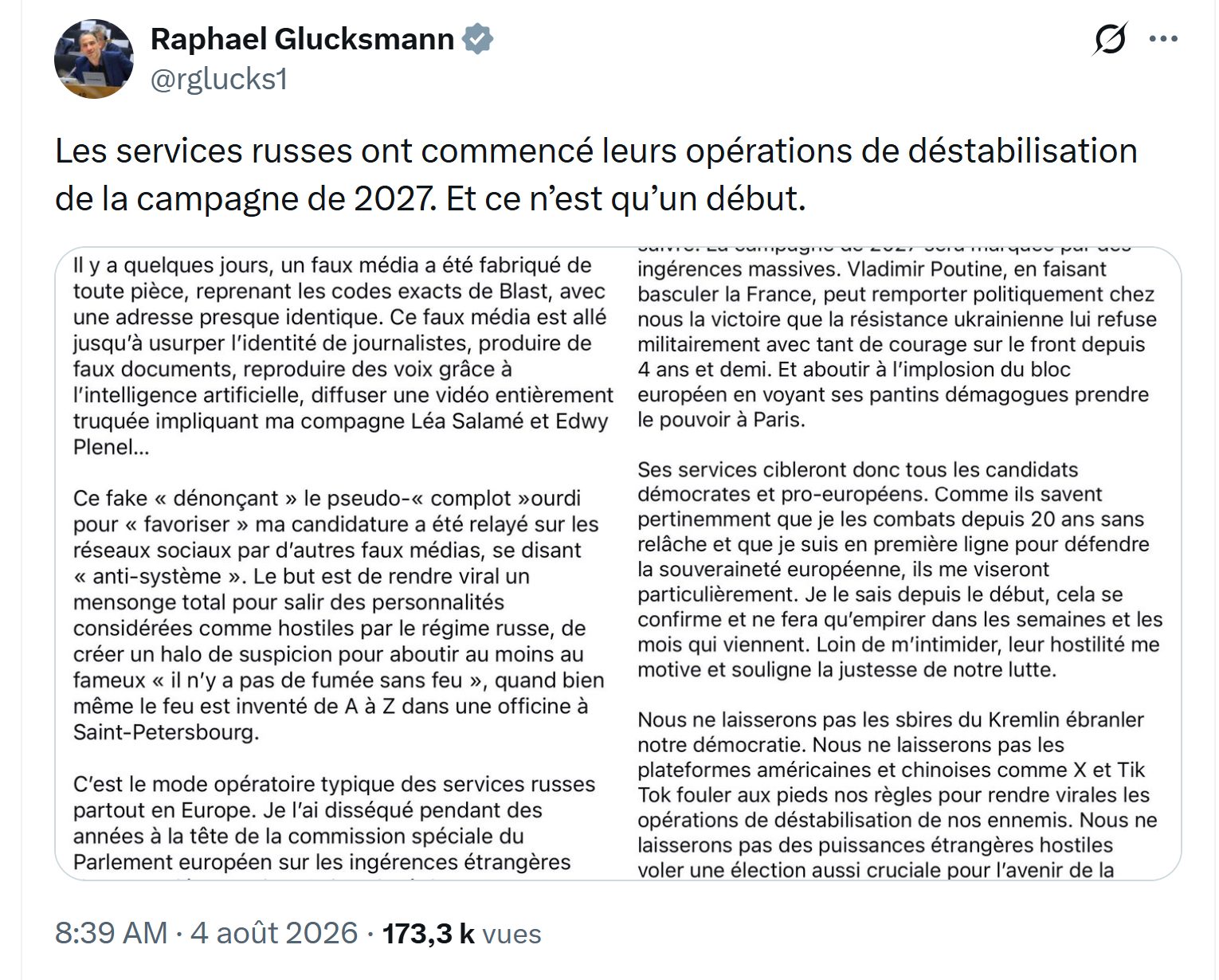
On August 4, 2026, Raphaël Glucksmann published a long post on X: he said he had been the target of a destabilisation operation attributed to the "Russian services." A fake media outlet reproducing Blast's exact codes, a nearly identical web address, voices reproduced by artificial intelligence, a completely faked video involving Léa Salamé and Edwy Plenel. The MEP, a potential candidate for the 2027 presidential election, said he had been alerted by the General Secretariat for Defence and National Security, which oversees VIGINUM, the service tasked with protecting against foreign digital interference. His verdict comes in four words: "This is only the beginning. The 2027 campaign will be marked by massive interference."
If you have read Chapter 1 of Dileviathan, this sequence should ring a bell.
In the novel, Gabriel Moreau, surprise candidate in the presidential election, discovers on his X feed a video of himself, filmed thirty minutes earlier at the market. Someone filmed it, edited it, published it. He plays it: "His face, his gestures, his voice. The words were different: not much, just enough." He posts a denial: "I never said that. The video has been altered. Here is the original speech." Too late. He scrolls through the comments: "People he did not know, who had never met him, who now hated him for words he had never spoken."
The novel was written before the Glucksmann affair. Reality has just caught up with fiction, and the comparison teaches three things.
First lesson: a deepfake does not need to be perfect, it needs to go viral. "Not much, just enough": Gabriel's video does not have to be flawless, only plausible. Raphaël Glucksmann says the same thing in politics: "The goal is to make a total lie go viral to smear figures considered hostile by the Russian regime, to create a halo of suspicion leading at least to the famous 'there's no smoke without fire', even though the fire was invented from A to Z in an office in Saint Petersburg." Technical quality matters less than the speed of spread.
Second lesson: denial fixes nothing. Gabriel publishes the original video, he proves, he explains. The comments keep rising. Anger does not answer facts, it answers images. That is the "halo of suspicion" mechanism described by Raphaël Glucksmann: once doubt is sown, proof does not dispel it, it feeds it.
Third lesson: fiction goes further than the news story. In Dileviathan, the deepfake is not an accident from abroad: it is a cog in an architecture. The novel describes a system, VIVRE, the Dileviathan, that captures, analyses and steers data, and for which manipulation is just one function among others. Foreign interference remains an occasional operation, however massive. Fiction asks the question factual reporting avoids: what if manipulation were not the exception, but the rule of the system?
Safeguards exist. VIGINUM, created in 2021 and attached to the General Secretariat for Defence and National Security, detected and characterised the operation against Raphaël Glucksmann, who was informed before the fake video spread. The service does what it can with the means it has: a small team, public reports, platform cooperation still to be built. The law against information manipulation completes the toolkit. The race remains uneven: making a fake media outlet takes hours, characterising it officially takes days. But detection exists, and it worked.
"This is only the beginning," warns Raphaël Glucksmann. In Dileviathan, Chapter 1 is also only the beginning: the altered video opens an escalation that drives the candidate into hiding. The line between fiction and reality thins a little more every day. That is precisely why fiction is worth reading: it is the instruction manual for the crises to come.
Sources:
"This is only the beginning": Raphaël Glucksmann denounces a destabilisation operation by the "Russian services" against him — BFMTV
VIGINUM — Wikipedia
Raphaël Glucksmann — Wikipedia
Blast — Wikipedia
Dileviathan, Chapter 1 — Seventy-Two
Publié le August 5, 2026 par Christophe Wiest
Articles similaires
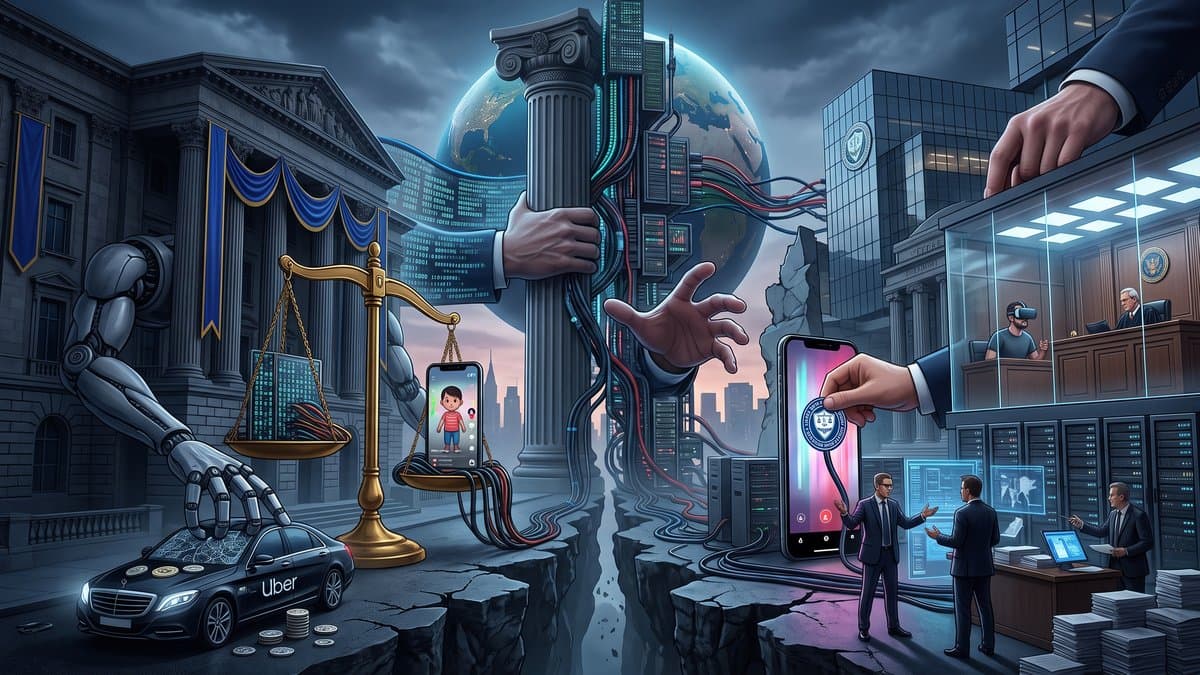
Platform regulation: Europe collects, America judges
The week of August 17, 2026 will go down in the annals of digital regulation as the one in which three blows were struck, almost simultaneously, on two continents and under two distinct legal regimes.
29 août 2026
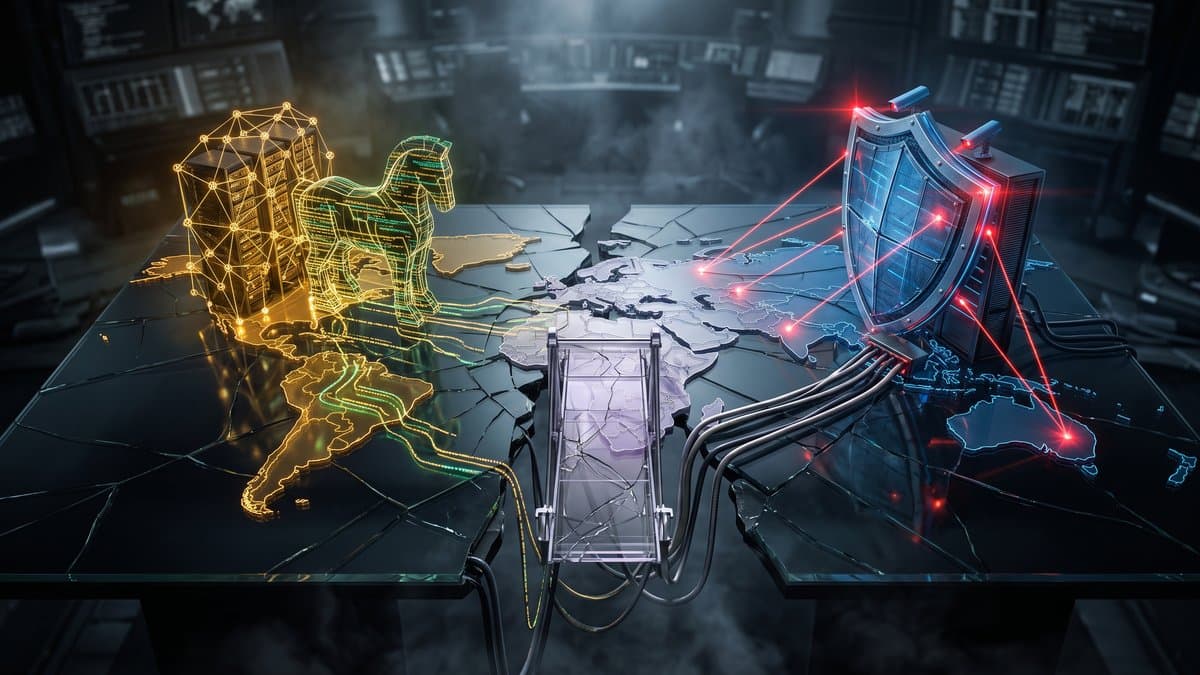
AI Has Become a Geopolitical Weapon: Welcome to the Multipolar World
Summer 2026 will go down as the moment artificial intelligence stopped being a mere technological topic and became a matter of pure power.
28 août 2026

AI dependence: when the tool becomes a cognitive crutch
"I've lost count of how many times I turn to Claude": this confession from a French entrepreneur, reported by Les Echos, says something about our relationship with artificial intelligence.
27 août 2026