Technopolitical Blog
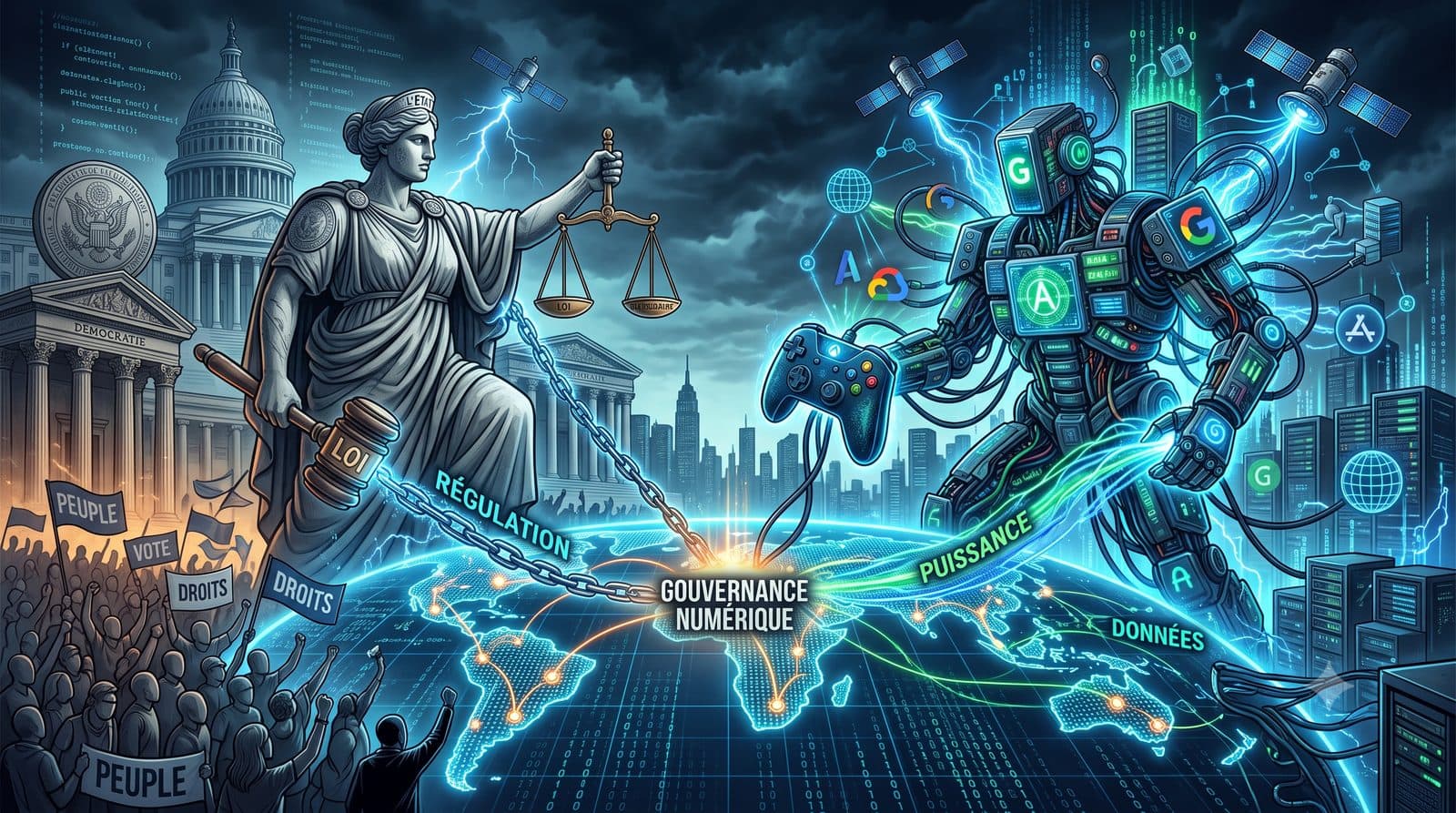
Big Tech vs. the State: Who Really Governs the Digital World?
Meta decides who gets to speak. Google knows where you're going. SpaceX controls Internet access in wartime. Do states still have the final say?
Key takeaways:
- Big Tech companies are no longer mere businesses — they are hybrid political entities
- Their power exceeds that of most states, yet they lack democratic legitimacy
- The relationship between Big Tech and the state is neither conspiracy nor open warfare: it is an ambivalent codependence
- The central question is not technical but political: "Who decides?"
2. The concept: an asymmetric codependence
2.1. What Big Tech actually is
Asma Mhalla offers an essential analytical framework:
"Public and regulatory debate focuses on the upstream — what Big Tech does. The downstream is forgotten: what it is."
— Interview Le politique à l'ère numérique
Video source
What they are is an unprecedented hybrid:
| Dimension | Analysis |
|---|---|
| Legal | Private companies — accountable only to the market |
| Economic | Unparalleled market power (monopolies or oligopolies) |
| Political | Civilizational infrastructures — deciding who speaks, sees, communicates |
| Military | Contractors for the Pentagon and armed forces worldwide |
| Diplomatic | Autonomous techplomacy — negotiating directly with states |
Éric Sadin, in La silicolonisation du monde (2016), analyzes this phenomenon as a "silent coup d'état": Silicon Valley imposes a model of society built on the technical resolution of every political question.
2.2. The infraSystem
Asma Mhalla coins the concept of the infraSystem to describe what Big Tech has become:
"Big Tech is the infraSystem — the invisible architecture on which society rests. Meta, Alphabet, Amazon, Microsoft, X-Corp are no longer mere companies: they are geopolitical conglomerates."
— Technopolitique, chapter 1
This idea echoes Frank Pasquale's analysis in The Black Box Society (2015): algorithms operate as black boxes, rendering power invisible and uncontestable. Source
2.3. The two subgroups
Asma Mhalla distinguishes two categories of Big Tech:
| Group | Players | Logic | Example |
|---|---|---|---|
| Opportunistic metaplatforms | Google, Meta, Apple, Amazon, Microsoft | Collaboration through economic agnosticism | Selling cloud services to both the Pentagon and China |
| Ideological hard core | Palantir (Peter Thiel), Elon Musk, OpenAI | Worldview, political project | Refusing to sell to certain states, ideological lobbying |
Peter Thiel, co-founder of PayPal and Palantir, is the central figure of the second group. In his essay The Straussian Moment, he argues that democracy is a "dictatorship of the average" that must be defeated in the name of innovation.
"Peter Thiel regards democracy as a 'dictatorship of the average' that must be defeated in the name of innovation by a superior elite."
— Asma Mhalla, conference Technopolitique
Video source
3. In practice: four concrete cases
3.1. Who moderates speech?
Meta (Facebook, Instagram, WhatsApp) employs thousands of moderators and deploys algorithms to determine what is and is not acceptable. This determination is:
Private — Meta is not bound by the American Constitution (First Amendment) or European laws in the same way states are
Global — a decision made in Menlo Park applies equally in Nigeria and France
Opaque — moderation algorithms are trade secrets
Asma Mhalla highlights the paradox:
"Freedom of expression, a fundamental liberty in our states governed by the rule of law, itself becomes an ideological masquerade. Elon Musk is not defending freedom of expression — he is producing a concept emptied of its original meaning and turned into a tool of power."
— Cyberpunk: le nouveau système totalitaire
3.2. Who controls data?
The American Cloud Act (2018) allows U.S. authorities to access data stored by American companies anywhere in the world. The result: the data of a French citizen stored with Microsoft in Paris is accessible to the FBI.
The Schrems II ruling by the Court of Justice of the European Union (2020) invalidated the Privacy Shield framework governing EU–U.S. data transfers. Yet in practice, data continues to flow — because the technical and economic architecture demands it.
3.3. Who wages war?
In Ukraine, Starlink has become a critical military infrastructure. Elon Musk personally decided whether to activate or deactivate the service in certain areas — without going through the Pentagon or Congress.
"There is no grand conspiracy — rather, objective alliances that shift by domain: cooperation on military matters, conflict over social media regulation."
— Asma Mhalla, conference Technopolitique
Video source
3.4. Who regulates AI?
The European AI Act (2024) classifies AI systems by risk level. But as Asma Mhalla observes:
"Vertical regulatory responses are twentieth-century answers to a twenty-first-century phenomenon."
— Conference Technopolitique
Video source
While Europe regulates, the United States invests and China deploys. Mistral AI, the French startup, has aligned itself with Microsoft's cloud — a perfect illustration of European dependency.
"We are paying the price of 40 years of total absence of political vision in matters of industry and technology."
— Asma Mhalla, The Age of AI
Video source
4. What next? — Breaking free from powerlessness
4.1. The common carrier proposal
Asma Mhalla proposes treating platforms as public carriers:
The same principle that governed railways in the nineteenth century or electricity in the twentieth
Universal service obligations, non-discrimination, transparency
Democratic governance of the infrastructure
"The real black box is not the algorithm — it is governance."
— Asma Mhalla, conference Technopolitique
Video source
4.2. European sovereignty: a niche strategy
Asma Mhalla is clear-eyed about Europe's limitations:
"Europe does not have the means for American or Chinese gigantism; it must develop niche strategies backed by a genuine industrial policy."
— Conference Technopolitique
Video source
Concrete proposals exist: sovereign cloud infrastructure, critical European infrastructure, standardization as a geopolitical weapon, algorithmic regulation.
4.3. The question no one is asking
At its core, the central question is not technical but political. As Asma Mhalla repeatedly insists:
"The question is not 'how does it work' but 'who decides, and how do we wish to be governed?'"
— Conference Technopolitique, The Age of AI
Sources and The age of AI
📚 Sources
🎬 Videos
| Source | Link | Subject |
|---|---|---|
| Asma Mhalla — Technopolitique | YouTube | Big State, infraSystem, Big Tech ideologies |
| Asma Mhalla — Cyberpunk | YouTube | Big State/Big Tech, the two-headed Leviathan |
| Asma Mhalla — Le politique à l'ère numérique | YouTube | What Big Tech is vs. what it does |
| Asma Mhalla — The Age of AI | YouTube | Europe's lag, AI governance |
| Asma Mhalla — Qui contrôle le monde | YouTube | Architecture of power, states vs. corporations |
📕 Books
| Work | Author | Year | Relevance |
|---|---|---|---|
| Technopolitique | Asma Mhalla | 2022 | InfraSystem, codependence, common carrier |
| Cyberpunk | Asma Mhalla | 2025 | Dileviathan, simulacrum fascism, resistance |
| La silicolonisation du monde | Éric Sadin | 2016 | Silicon Valley's silent coup d'état |
| The Black Box Society | Frank Pasquale | 2015 | Algorithms as black boxes of power |
Publié le August 10, 2026 par Christophe Wiest
Articles similaires
Social Media for Minors: Is the Constitutional Council Opening a Regulatory Dead End?
On August 14, 2026, the Constitutional Council struck down Article 1 of the law banning social media access for minors under 15.
21 août 2026
Hacking the Tax Authority: When a Cyberattack Becomes a Matter of State
On August 14, 2026, the tax administration acknowledged an intrusion into its systems.
19 août 2026
Cognitive Warfare: Your Brain Is a Front Line
How the concept of "cognitive warfare" moved from science fiction to official military doctrine — and why it concerns you, even if you never go to war.
13 août 2026